The Power of Compound Interest: Why Starting Early Matters More Than You Think
One of the most important concepts in investing is also one of the simplest: compound interest.
Most people understand the basic idea that investing can help your money grow. What many people underestimate is how dramatically time can impact the outcome.
When people think about building wealth, they often focus on finding the right investment, earning a higher return, or predicting where the market is headed next. While those things receive a lot of attention, they are often far less important than a much simpler factor: how long your money remains invested.
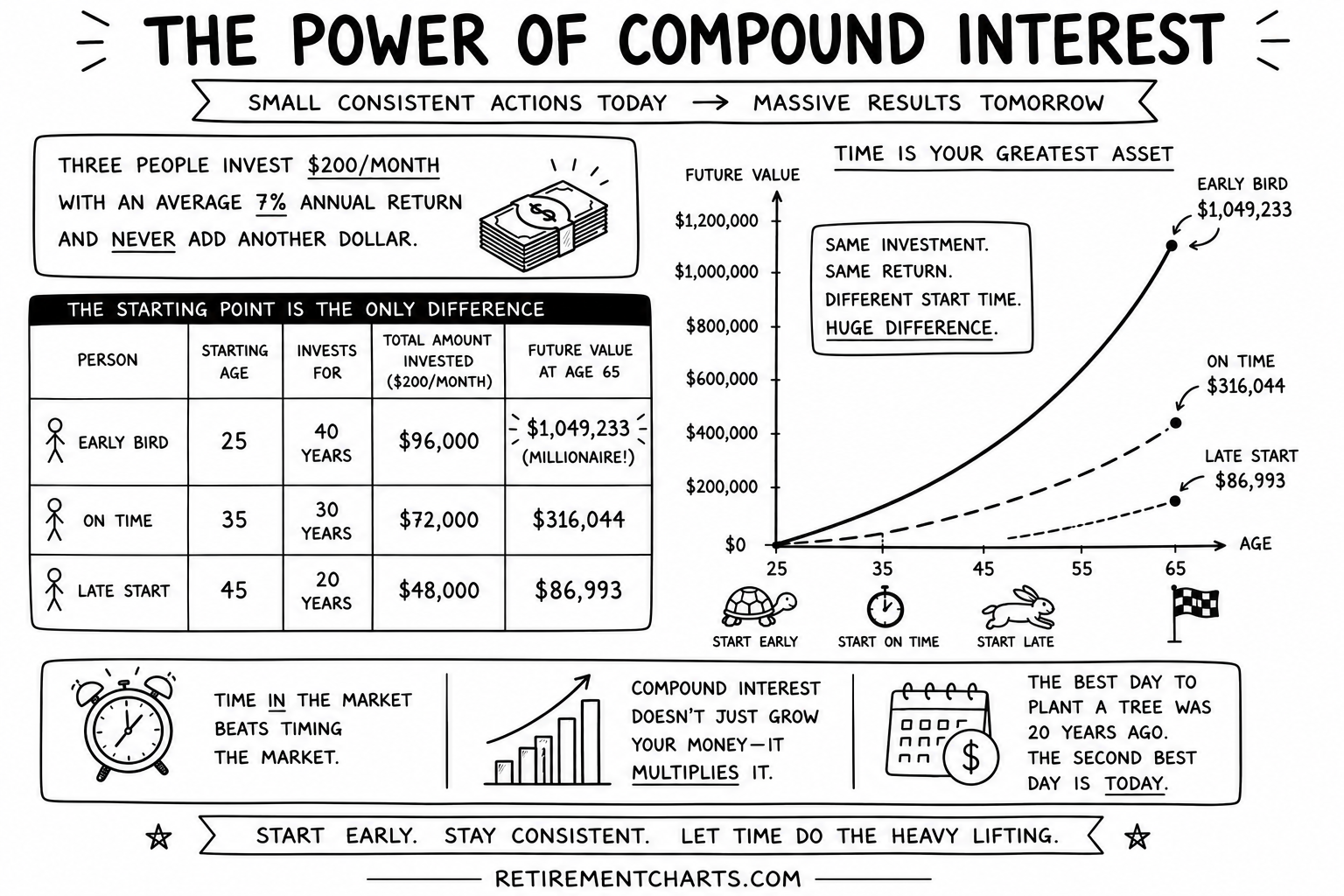
The chart above demonstrates this concept clearly.
In our example, three people invest exactly the same amount of money. Each person contributes $200 per month and earns an average annual return of 7 percent. The only difference between them is when they start.
The first investor begins at age 25. The second starts at age 35. The third waits until age 45.
Same contribution.
Same return.
Same discipline.
Different starting point.
The results are remarkable.
The Investor Who Started at 25
Our first investor contributes $200 per month beginning at age 25 and continues investing until age 65.
Over forty years, this investor contributes a total of $96,000.
Many people are surprised by that number. Less than $100,000 of total contributions does not seem like enough to create substantial wealth.
Yet by age 65, the account grows to approximately $1,049,233.
That means the vast majority of the final balance did not come from contributions. It came from investment growth.
The money generated returns, and those returns generated additional returns. Over time, the growth became increasingly powerful.
This is compound interest at work.
The Investor Who Waited Until 35
The second investor waits ten years before getting started.
Everything else remains identical.
The contribution is still $200 per month.
The return is still 7 percent.
The investor simply delays getting started.
Over thirty years, this investor contributes a total of $72,000.
By age 65, the account grows to approximately $316,044.
That is still a meaningful amount of money. However, compare it to the investor who started at age 25.
A ten year delay reduced the final account value by more than $700,000.
Think about that for a moment.
The difference was not investment skill.
The difference was not a better return.
The difference was simply time.
The Investor Who Waited Until 45
The third investor waits until age 45 before starting.
Again, everything else remains exactly the same.
This investor contributes $48,000 over twenty years and reaches approximately $86,993 by age 65.
Compared to the investor who started at age 25, the difference is staggering.
The first investor accumulated more than $1 million.
The third investor accumulated less than $100,000.
The lesson is clear. Compound interest rewards those who give it time to work.
Why Time Matters So Much
Many investors assume the magic of compound interest comes from earning a high return.
In reality, the bigger factor is often time.
A 7 percent return for forty years can produce dramatically different results than a 7 percent return for twenty years.
The return did not change.
The amount invested did not change.
The only thing that changed was the number of years available for compounding.
This is why financial planners often emphasize starting early.
The earlier you begin, the more opportunities your money has to compound.
Each year builds upon the previous year. Eventually, growth begins to accelerate.
At first, the progress can feel slow. Contributions account for most of the increase in value. Later, investment gains begin to contribute more than the investor does.
Eventually, the account starts growing because of the growth that has already occurred.
That is when compound interest becomes truly powerful.
Time in the Market Beats Timing the Market
One of the most common investing mistakes is waiting for the perfect moment to begin.
Many people convince themselves they will start investing after the next market correction, after interest rates fall, after an election, or after they feel more confident.
Unfortunately, those perfect opportunities rarely arrive in the way people expect.
Meanwhile, valuable years pass by.
The reality is that nobody consistently knows where markets will go over the next month or the next year.
What we do know is that historically, patient investors who remained invested over long periods have generally been rewarded.
This is why time in the market often matters more than timing the market.
Getting started is usually more important than getting it perfect.
Consistency Matters More Than Perfection
Another important lesson from this chart is that building wealth does not necessarily require large amounts of money.
Many people delay investing because they believe they need thousands of dollars to get started.
The truth is that consistent investing can be remarkably effective.
In our example, the investor who accumulated more than $1 million invested just $200 per month.
That amount may not seem life changing in any single month. However, over decades, the combination of consistency and compound growth produced extraordinary results.
The key is developing the habit.
Invest regularly.
Stay disciplined.
Remain patient.
Allow time to do the heavy lifting.
The Best Time to Start
A common saying in investing is that the best time to plant a tree was twenty years ago. The second best time is today.
The same principle applies to investing.
If you are in your twenties, start now.
If you are in your thirties, start now.
If you are in your forties or fifties, start now.
You cannot recover lost years, but you can make the most of the years ahead.
Every year you wait is one less year for compound interest to work on your behalf.
The Bottom Line
Compound interest is one of the most powerful forces available to investors.
The chart demonstrates a simple truth: starting early can matter more than almost anything else.
The investor who began at age 25 invested only $96,000 and accumulated more than $1 million.
The investor who waited until age 45 invested half as much and accumulated less than $100,000.
The difference was not investment selection.
The difference was not market timing.
The difference was time.
If there is one lesson every investor should remember, it is this:
Start early. Stay consistent. Let time do the heavy lifting.